Duct Work
Duct Inspection & Replacement
A healthy AC or furnace still loses the fight if the ductwork carrying its air is torn, crushed, or disconnected in the attic.
The attic is not a neutral place for conditioned air to travel
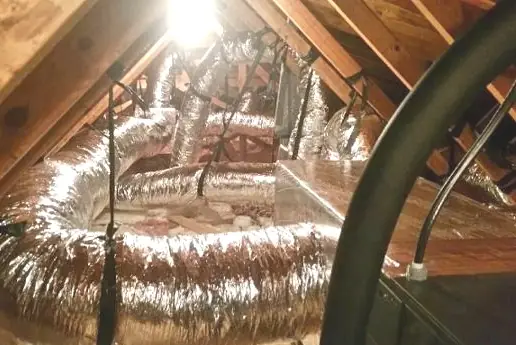
A Texas attic in July can sit well past 130 degrees. Every foot of duct run up there is fighting that heat from the outside while trying to deliver 55 degree air to a bedroom on the other end of the house. Insulation wrap and sealed joints are what make that trip possible at all. Once a joint separates, a run gets crushed under stored boxes, or a flex duct develops a tear, the system is now paying to condition attic air along with the air in your house, and the room at the end of that run is the one that never quite feels right no matter how the thermostat is set.
What we're actually looking for up there
A duct inspection means getting into the attic and walking every run: checking insulation wrap for gaps, checking connections at the plenum and at each boot, looking for crushed or kinked flex, and confirming the system is actually delivering the airflow it was designed to move. If a section can be sealed and re-hung, we say so. If a run has degraded past the point of a reasonable patch, we'll tell you that too, and walk you through what a duct upgrade or a full duct work replacement would involve before you decide anything. Estimates on this work are free.
AirLoom. NATE certified technicians serving The Woodlands and Conroe. Call (936) 202-3390.
Why leaking ducts cost more than a leaking window
A window leak loses conditioned air one room at a time and you can usually feel it. A duct leak in the attic loses that same air before it ever reaches a room, so the only symptom is a system that runs longer, a power bill that runs higher, and a thermostat reading that never quite matches how the house actually feels. The equipment itself can be in perfect condition and still fail to deliver, because the path between the unit and the vent is the part doing the losing.
This is also why a duct problem so often gets misdiagnosed as an equipment problem. Homeowners replace a perfectly good AC or furnace and see only a partial improvement, because the new unit is still pushing air through the same compromised runs the old one was.
Inspection, upgrade, or full replacement
Duct Inspection
A full walk of every accessible run: insulation condition, connection points, crushed or kinked sections, and whether the airflow reaching each room matches what the system was designed to deliver. This is the starting point whenever a room runs hot or cold and the equipment checks out fine.
Duct Upgrade
Re-sealing joints, re-wrapping exposed insulation, re-hanging sagging or crushed sections, and correcting the specific spots an inspection flagged. Most attics we find need targeted work like this rather than a wholesale tear-out.
Duct Work Replacement
When the material itself has degraded past a reasonable patch, most often on an older home, the full run gets replaced with new insulated duct sized to match what your AC and heater actually need to move. We size it to the system, not to whatever was up there before.
When replacement is the honest answer
Duct material has a working life, same as any other part of the system, and a run that has spent decades baking in a Woodlands attic eventually reaches the point where sealing one joint just moves the failure to the next one. Once we see that pattern across a run, patching it is a short-term fix that costs you twice. We'll say so plainly, show you what we found, and let you weigh a duct upgrade against a full replacement with the actual condition of your attic in front of you, not a guess.
Get the ducts looked at before you replace anything else
If a room in your Woodlands or Conroe home has never quite kept up, start in the attic before you spend on new equipment. The estimate is free, the inspection is thorough, and what we find is exactly what we'll tell you.
See the rest of what keeps a system running right: all services or indoor air quality.